
Library member Diana Wayne sought information and inspiration from the library whilst planning her rail trip in Canada last Summer. Searching our shelves, Diana found just the thing – and wrote this wonderful story about the book she discovered and her travels…
“Dear Librarians at Morrab Library,
Firstly, I sincerely apologise for keeping a book for so long without renewing it. I have now renewed it again. When I lifted this book off the shelves, it was as if it should stay with me and as I type this, it sits next to me like a cat needing to be stroked.
Before I went away, I had acquired a fairly modern guide book for my trip to Canada, from the Clarence House Therapy Centre Fundraising Book selection in the Waiting Room, another source for discerning reading matter. That book had lists of facts, stock photographs and maps, but it had no heart.
I visited the Morrab Library, hoping to find something else about the destination because I planned to keep a pictorial diary of the journey. With only a few feet of Canadian information, the designated shelf looked uninviting, but it felt like a personal invitation to reach out to this particular book. A torn cover, a preface dated 1926, with anecdotes from the early 1800s and thick, soft, tactile pages, this book seemed just what I needed to enhance my journey. I had no idea, at that time, how much it would illuminate my own travel and my notebook.
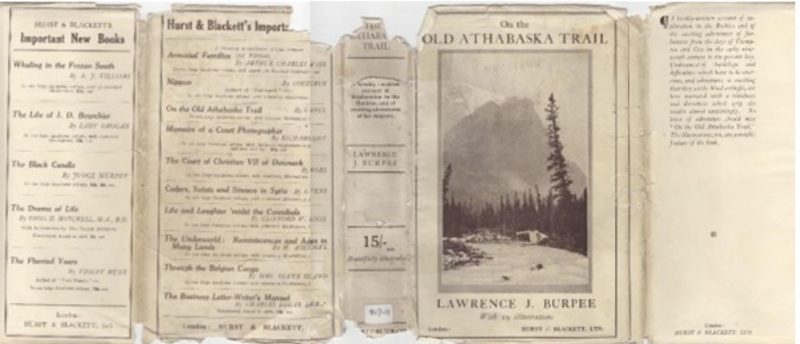
Author, Lawence J. Burpee wrote ‘On the Old Athabaska Trail’ about his own experiences a hundred years ago, while comparing them to previous travellers through that particular part of the Rocky Mountains a hundred years before that.
Every page is riveting, for instance page 182:
‘The Indians in the neighbourhood of Jasper House numbered only about fifteen or twenty. They were, according to Kane, of the Shoo-Schawp (Shuswap) tribe, of whom he made a sketch, was called Capote Blanc by the voyageurs. His real home was a long distance to the north-east (Kane must have meant to say south-west), but ’he had been treacherously entrapped whilst travelling with thirty-seven of his people, by a hostile tribe, which met him and invited him to sit down and smoke the pipe of peace. They unsuspectingly laid down their arms but before they had time to smoke their treacherous hosts seized their arms and murdered all except eleven, who managed to escape, and fled to Jasper House, where they remained, never daring to return to their own country through the hostile tribe’.…
‘A day or too later they started up the valley of Athabaska, with thirteen loaded horses…..’
How could I resist? I hoped that my travels might include these places.
I read the book twice before leaving for Canada, and made copious notes, but in the end, it made its way into my hand luggage.
I loved the anecdotes: like the mountain that was named twice by early European travellers, because they had approached it from different directions. Of course, the original indigenous names were usually ignored.
The book was giving me a real insight into those Canadian years.
I started to acquire large scale maps and then I realised that we would be staying at the town of Jasper, regularly mentioned in the book. Familiar names, apart from Athabaska, started to leap out at me, like the Kootenay, one of the names for the original local people, who would trade with Burpee.
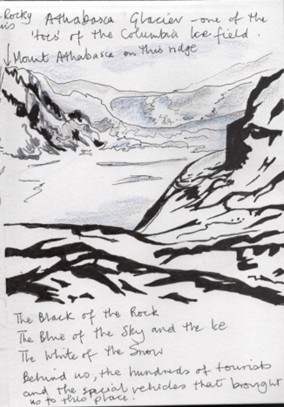
From arriving in east Canada, our journey took thirteen days of rail travel and city touring to reach the mountains and the Athabaska River at the town of Jasper.
And there it was, a short walk beyond the railway line and amidst the elks and the prairie dogs, made longer by having to wait at a rail crossing for about 200 freight wagons to pass.
It was hidden in a canyon that was hard to reach, but it was still there.
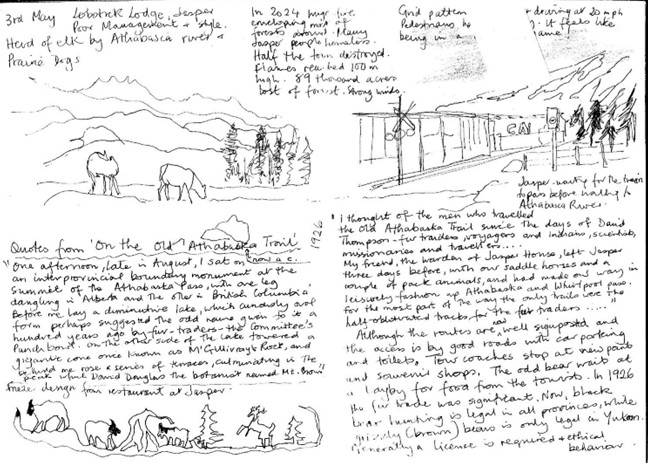
I wanted to use the book to compare with aspects of the modern Jasper, but last year a major fire burnt down half of the town and over 80 thousand acres of surrounding forest.
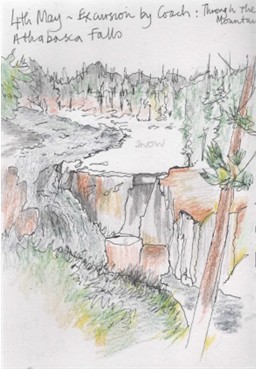
A typical passage on Page 182 about the Athabaska Falls reads:
‘It hurls itself into a gloomy, awe-inspiring cavern, writhes itself there in a fury for a moment, and then flips itself down a tortuous gorge. The sullen roar of its passage could be heard while we were still down the Trail.’ Lawrence J Burpee 1926
Ross Cox went through the Pass in 1817 on page 91
The Falls are just the same today, except for the safety rails for visitors.
Now tour buses follow parts of the same Athabaska route through the mountains, with the odd bear or moose waiting in a layby for a snack. I found the places that I wished for and are still the highlight of my journey.
Niagara Falls was interesting, but Athabaska Falls will stay with me.
Thank you Morrab Library.”
Diana Wayne, July 2025