
Blog
IMPORTANT INFORMATION ABOUT CAR PARKING AT THE LIBRARY.
We need to share some important news about car parking over the next few weeks. The Honorary Health and Safety Officer, on behalf of the Trustees, has arranged for the external building to be painted and redecorated over the summer. This means that scaffolding will be erected around the entire building for the duration of the works.
As typical of works involving scaffolding, we do not have an exact date for the work commencing, but we have been informed that the scaffolding could be put up as early as the 23rd of June, but more likely the week beginning the 26th of June. Until it is up, we won’t know how much of an impact it will have on access to all of our parking spaces. Some may be restricted for the entirety of the project, but we do not know as yet.
We do know for now that the painters have recommended that while they are refurbishing each side of building’s front that parking be avoided for that period, to reduce the risk of your car getting a new coat of paint! We know the work to paint commences from 3rd July, but we do not have any indication of how long it will take to finish each of these sections. We will provide updates as we find out more.
The work is estimated to take up to two months in total before the scaffolding is subsequently removed.
Ideally, it would be very helpful if you could avoid parking at the library entirely during this period if possible, so we can ensure those who need it the most can be guaranteed access.
But at the least, may we recommend throughout this period that you phone ahead if you need a car park to access the library and we can inform you of the state of play on the day you require it.
We’re sorry we can’t be more definitive at this stage, and we hope to have more of a steer as the work commences, but we wanted you to know in advance of potential limitations and inconvenience the works may cause.
So please get in touch with any queries, and we will do our best to accommodate and support your visit. At the end of this, the library will be looking beautiful and refreshed! Thank you for your support, as always.
Best wishes from the library team and Trustees.
Help Us Create Our Penwith Futures Book
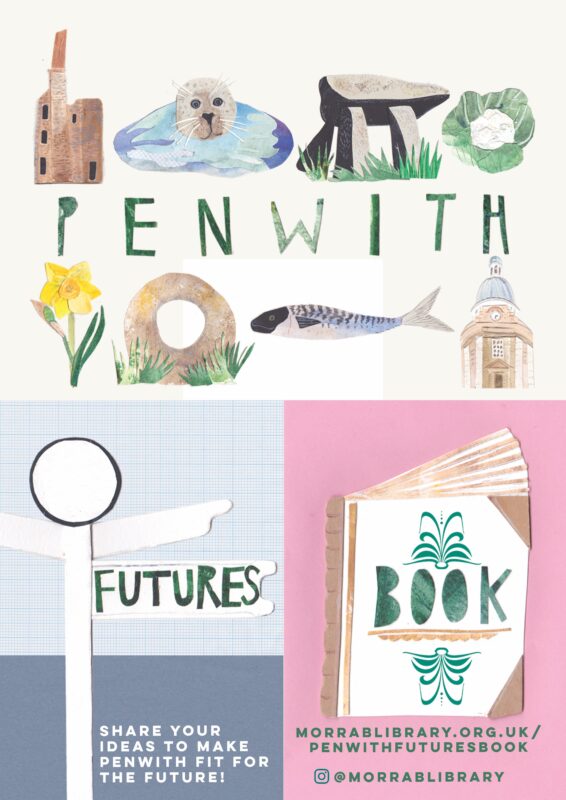
Over the past year you may have seen our Penwith Futures Book postcards and posters in the library and while you’re out and about. We really hope you’ve pinned them to your noticeboard, popped them on the fridge or tucked them inside your bedtime reading as bookmarks, but most of all we hope that you have been mulling over your ideas to contribute to the ‘Penwith Futures Book’.
We’ve received some brilliant submissions so far and lots of interest from members – thank you all – but if you haven’t sent anything in yet we would like to encourage you to put pen to paper and send us your ideas.
As a quick reminder, or a brief introduction for our new members, here is a bit of information about the book and answers to some of the questions you may have…
What is the Penwith Futures Book?
The Penwith Futures Book will be a compendium of your brightest ideas for the future of our local area. We would like you to imagine and then write down what a more environmentally friendly and socially just future could look like locally. We’ll put it all together into one big beautiful book for all to read.
What should I write?
There is no right answer. The entries we have received from people so far have been a personal representation of what really matters to them – reflecting on what they love about living in Penwith, the things they cherish about the landscape, our community and the history of this special corner of West Cornwall – as well as looking hard at some of the problems we’re facing due to the climate crisis.
They have shared their hope and visions for the future – including greater access to nature for all, Cornish lessons for school children, and plastic-free beaches – and given ideas to help steer us there too.
Do you have any examples of other people’s entries to help inspire us?
Here are a couple of excerpts from entries to give you some ideas:
“The rivers and ocean are sewage free thanks to strong government intervention and composting toilets are being installed in all new homes. Now wildlife and people can swim in peace. Several Tidal Power hubs float gently in the distance of Mount’s Bay generating enough clean electricity to power over 10,000 homes without pollution or waste. Windmills proudly stand in the Bay contributing to the
sustainable electricity supply.”
Rich Stever, Founder and Chair of the registered start-up charity, Earth’s Green Guardians (EGG) based in Cornwall, UK.
“How great would it be if Penwith could lead the way in teaching Cornish to an entire generation? To reclaim our forefathers’ language and give its gift to the youngest in our community for them, in turn, to pass on to subsequent generations. To watch the Cornish language flourish beyond the coasts and moors of Penwith.”
Kensa Broadhurst, PhD student.
How can I send in my ideas?
Your entry can be typed or hand written in any style. It could be in bullet points or rhyming couplets, in comic book frames or scribbled jottings, a typed paragraph or spider diagram. We want it to be representative of the people of Penwith, expressed naturally, so please be as creative as you like, adding illustrations, doodles, artwork, maps or photographs to help communicate your ideas.
We only ask that you keep your entries to under 400 words (or up to A4 size if submitting any artwork) and that you submit them by the end of April 2023 either by dropping them in to the library, posting them (Morrab Library, Morrab Gardens, Penzance, Cornwall TR18 4DA) or emailing them to harriet@morrablibrary.org.uk. Please include your name and contact information with your entry so we can chat to you about it.
What if I know some people who are not Morrab Library members but who might like to give their ideas for the book, can I share this with them?
Absolutely, yes!
Perhaps you’re a member of a local history society, or you’re part of a home-schooling group, a bunch of ramblers, a litter-picking tribe, a crocheting club or a choir. We’d love to hear from organisations too.
If you are part of a group that you think would like to share their ideas for the book, please encourage them to get in touch with Harriet (harriet@morrablibrary.org.uk) for more info.
You can also download our poster if you’d like to share it with friends and organisations locally or on social media to help us spread the word.
Mrs Borlase’s ‘minced Pyes’
Charlotte MacKenzie is currently researching Cornish legends and historical individuals, including healthcare and folk customs in Georgian Cornwall. She popped into the Morrab Library in the autumn to use our Archive for some of her research. Along the way, she encountered Mrs Borlase’s recipe for ‘Minced Pyes’ and Charlotte has kindly written a blog for us about them.
One of the hidden treasures of the Morrab Library is a manuscript recipe book compiled by the Borlase family at Castle Horneck. Which includes a recipe for ‘minced Pyes’.
To make minced Pyes
Take Eggs & boyle them very hard when cold then mince them very Small, to one pound of Eggs two pounds of beef Suett one pound of Currants & ye Same Seasoning as you doe to your other minced pyes.
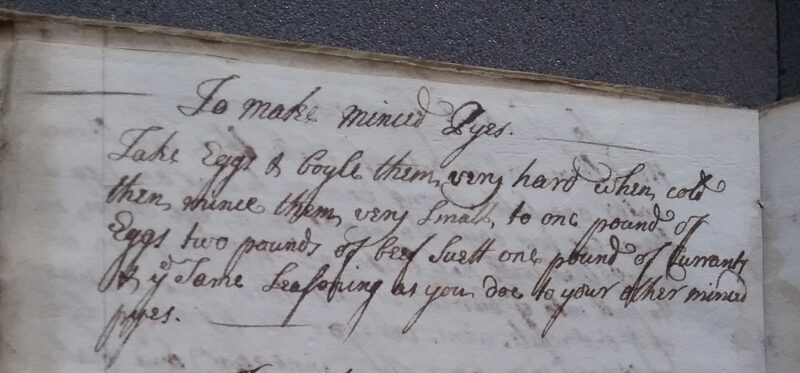
Charlotte’s photograph of Mrs Borlase’s recipe for ‘Minced Pyes’ which can be found in the Archive collection at Morrab Library
The quantities for the mincemeat filling suggest the household at Castle Horneck got through quite a lot of minced pies.
The book as a whole is of interest partly because it contains recipes and advice on family healthcare and first aid. Caring for family health, ailments, and illnesses was considered part of household management, which might also include attention to the well-being of horses or livestock. The Borlase family book was not unique. Recipe books like that of the Borlase family were mostly kept by women, whose responsibilities for family and household management included healthcare. And all kinds of recipes were sometimes shared between women in their family and social circles.
The book is organised as collections of recipes. For coughs, colds, fevers, headaches, itches, and digestive disorders; and first aid for scalds and cuts. The recipes were intended to relieve acute symptoms and promote healing, and did not include general pain relief. Information about whether and when recipes were prepared and applied is lacking. Some entries have an annotation that the recipe came from a named individual, including some prescriptions by medical practitioners, or were copied for possible future use from published books or magazines.
The book includes one recipe for a topical application for the head to cure ‘madness’; and many concoctions for ailments at every life stage and in different parts of the body – from sore nipples (presumably of nursing mothers) to steadying giddiness in the head; as well as a small number of prescriptions from medical practitioners. Plus other household requisites such as how to make ink and hair dye, and recipes for horses.
Although the Borlase family could afford to consult medical practitioners – and sometimes did – Cornish recipe books confirm that households were partly self-reliant in managing health and illness.
It is an approach which can be seen in the writings of William Borlase, whose brother Walter’s family had lived at Castle Horneck. In the 1760s, the health of William’s wife Anne improved, and he wrote to a friend, the Cornish born physician William Oliver in Bath, that ‘Our only physick for the last year has been no other than the air on the beach below the house, where we daily make our almost only visits, and pick pebbles’. After being widowed, Borlase later wrote that his own prescription for health in old age was to ‘read, write, and ride’.