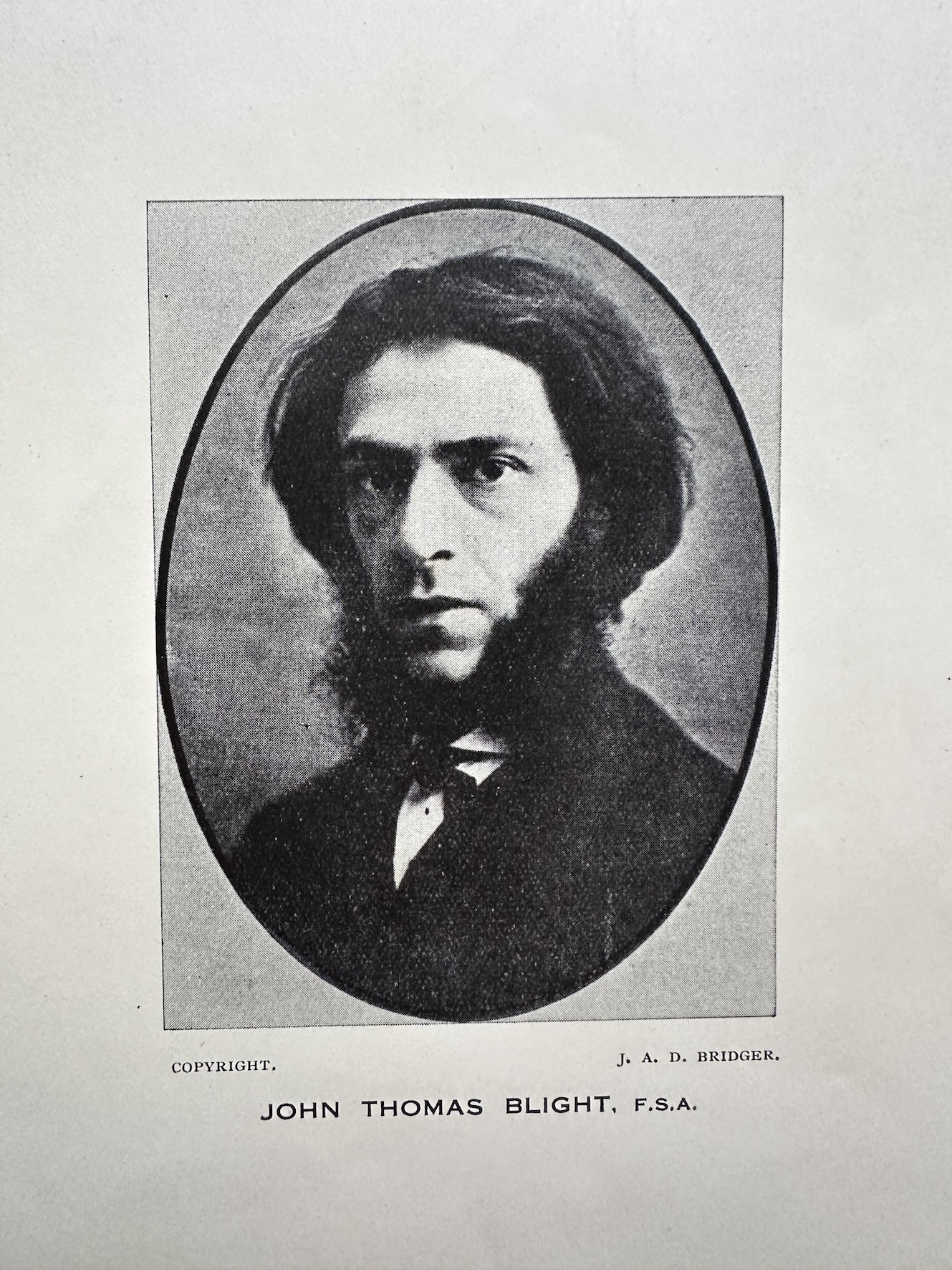
Library member Patricia Wilson Smith writes for us about J.T. Blight – part two
The fascinating and tragic story of J.T. Blight has captured the imagination of writers and artists over many years. Library member Patricia Wilson Smith has written the second instalment of a blog for us about how Blight‘s story has inspired her…
I’m reading A Week at the Lands End, John Blight’s third published work. The copy I hold in my hands was printed in 1861, and it thrills me to handle an early edition. What can it have meant to him, I wonder? As an artist myself, I imagine his excitement at seeing his work in print.
John Blight was 26, and had already published a detailed review of the ‘Ancient Crosses and Other Antiquities in the West of Cornwall’ ( 1857 ), followed by a similar treatise for East Cornwall (1858). He was attempting to preserve details of a large part of Cornwall’s history that was in danger of being swept away by a wave of Victorian modernisation.
His little ‘travelogue’, ‘A Week at the Lands End’ clearly had the growing tourist trade in mind, but was crammed with lovingly-detailed engravings of local wildlife and flora, tales of old superstitions, and recommendations for walks, as well as carefully recorded depictions of the sites of interest.

The frontispiece to ‘A Week at the Lands End’ – Could that be JTB, seated behind the couple in the foreground, intently sketching the scene?

Above: ‘The Irish Lady’. Below: ‘The Armed Knight’.

I’ve broadened my research, visiting Kresen Kernow, the Cornwall archive at Redruth, to view two letters from St Lawrence’s Hospital, (formerly Bodmin Asylum): letters replying to an enquiry from a member of the Helston Old Cornwall Society in 1968. The first letter, dated 5th February 1968 confirms –
‘He was admitted from 16 Morrab Place, Penzance…He was described as single, 32 (sic) years of age, and his occupation was Artist, FSA. Author. The supposed cause of his illness was stated to be overwork and overexcitement about a book he was writing’.
The second letter, one week later, raises an interesting question:
‘He was admitted on 25th May, 1871, he was classified as a Private Patient and the Form of Guarantee…was for one month only. However, from the correspondence it would appear that interested people or relatives were making arrangements for a further Guarantee of a longer duration…’
The ‘Form of Guarantee’ referred to a payment of 16 shillings for board and maintenance not exceeding one month. Whoever the interested parties were, they were successful, and Blight never escaped the confines of the asylum.
A subsequent visit to the Archive enabled me to view the Order for the Reception of a Private Patient, signed by John Blight’s father on 22 May 1871, before he was to travel by train, accompanied by two attendants, to Bodmin Asylum. Robert Blight stated that JTB had been ‘getting worse for nearly three years’, that he supposed the cause to be overwork, and that he had ‘lately been using threats of violence’. One wonders what was so disturbing this gentle, refined and talented artist, who was now described as suffering from delusions by the two medical professionals who signed the certificate confirming him to be of unsound mind.
© patricia wilson smith 2025