by Lisa Di Tommaso | Apr 5, 2026 | Blog
Library member Diana Wayne sought information and inspiration from the library whilst planning her rail trip in Canada last Summer. Searching our shelves, Diana found just the thing – and wrote this wonderful story about the book she discovered and her travels…
“Dear Librarians at Morrab Library,
Firstly, I sincerely apologise for keeping a book for so long without renewing it. I have now renewed it again. When I lifted this book off the shelves, it was as if it should stay with me and as I type this, it sits next to me like a cat needing to be stroked.
Before I went away, I had acquired a fairly modern guide book for my trip to Canada, from the Clarence House Therapy Centre Fundraising Book selection in the Waiting Room, another source for discerning reading matter. That book had lists of facts, stock photographs and maps, but it had no heart.
I visited the Morrab Library, hoping to find something else about the destination because I planned to keep a pictorial diary of the journey. With only a few feet of Canadian information, the designated shelf looked uninviting, but it felt like a personal invitation to reach out to this particular book. A torn cover, a preface dated 1926, with anecdotes from the early 1800s and thick, soft, tactile pages, this book seemed just what I needed to enhance my journey. I had no idea, at that time, how much it would illuminate my own travel and my notebook.
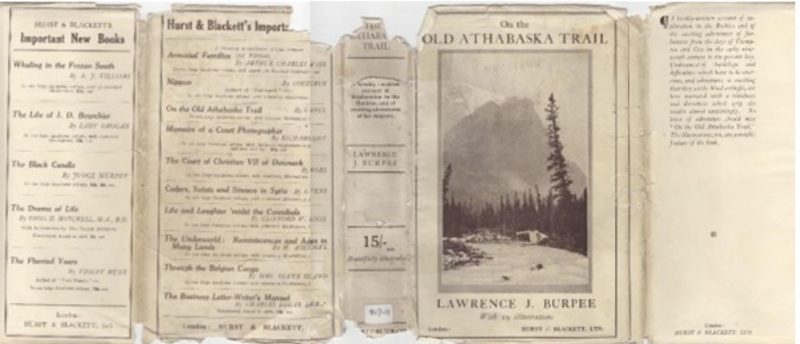
Author, Lawence J. Burpee wrote ‘On the Old Athabaska Trail’ about his own experiences a hundred years ago, while comparing them to previous travellers through that particular part of the Rocky Mountains a hundred years before that.
Every page is riveting, for instance page 182:
‘The Indians in the neighbourhood of Jasper House numbered only about fifteen or twenty. They were, according to Kane, of the Shoo-Schawp (Shuswap) tribe, of whom he made a sketch, was called Capote Blanc by the voyageurs. His real home was a long distance to the north-east (Kane must have meant to say south-west), but ’he had been treacherously entrapped whilst travelling with thirty-seven of his people, by a hostile tribe, which met him and invited him to sit down and smoke the pipe of peace. They unsuspectingly laid down their arms but before they had time to smoke their treacherous hosts seized their arms and murdered all except eleven, who managed to escape, and fled to Jasper House, where they remained, never daring to return to their own country through the hostile tribe’.…
‘A day or too later they started up the valley of Athabaska, with thirteen loaded horses…..’
How could I resist? I hoped that my travels might include these places.
I read the book twice before leaving for Canada, and made copious notes, but in the end, it made its way into my hand luggage.
I loved the anecdotes: like the mountain that was named twice by early European travellers, because they had approached it from different directions. Of course, the original indigenous names were usually ignored.
The book was giving me a real insight into those Canadian years.
I started to acquire large scale maps and then I realised that we would be staying at the town of Jasper, regularly mentioned in the book. Familiar names, apart from Athabaska, started to leap out at me, like the Kootenay, one of the names for the original local people, who would trade with Burpee.
From arriving in east Canada, our journey took thirteen days of rail travel and city touring to reach the mountains and the Athabaska River at the town of Jasper.
And there it was, a short walk beyond the railway line and amidst the elks and the prairie dogs, made longer by having to wait at a rail crossing for about 200 freight wagons to pass.
It was hidden in a canyon that was hard to reach, but it was still there.
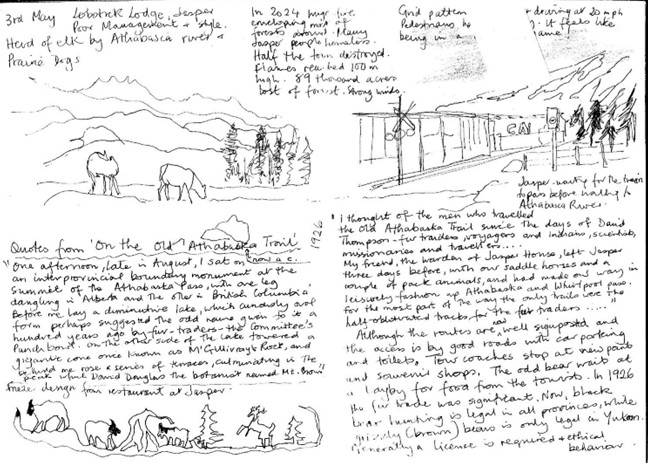
I wanted to use the book to compare with aspects of the modern Jasper, but last year a major fire burnt down half of the town and over 80 thousand acres of surrounding forest.
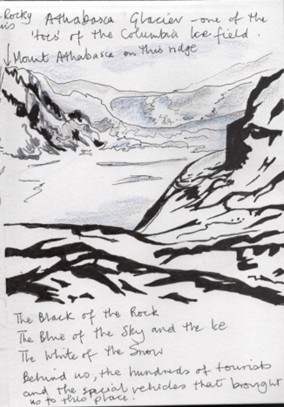
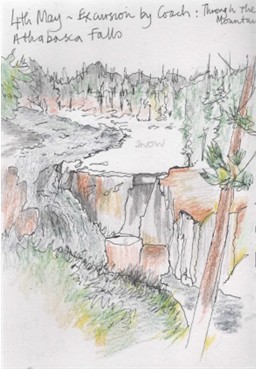
A typical passage on Page 182 about the Athabaska Falls reads:
‘It hurls itself into a gloomy, awe-inspiring cavern, writhes itself there in a fury for a moment, and then flips itself down a tortuous gorge. The sullen roar of its passage could be heard while we were still down the Trail.’ Lawrence J Burpee 1926
Ross Cox went through the Pass in 1817 on page 91
The Falls are just the same today, except for the safety rails for visitors.
Now tour buses follow parts of the same Athabaska route through the mountains, with the odd bear or moose waiting in a layby for a snack. I found the places that I wished for and are still the highlight of my journey.
Niagara Falls was interesting, but Athabaska Falls will stay with me.
Thank you Morrab Library.”
Diana Wayne, July 2025
by Lisa Di Tommaso | Mar 24, 2026 | Blog, Morrab Library
We are excited to tell you about a special new addition to the library – a purpose built display case. This will allow us to install a rotating exhibition of rare and important treasures from our book and archive collections, which are usually kept locked away in secure and environmentally protected storage. You’ll find it on the first floor at the top of the staircase.
We wanted to find a way to ensure that our members and visitors not only knew about the special collections we hold in the library, but to be able to see and learn about them.
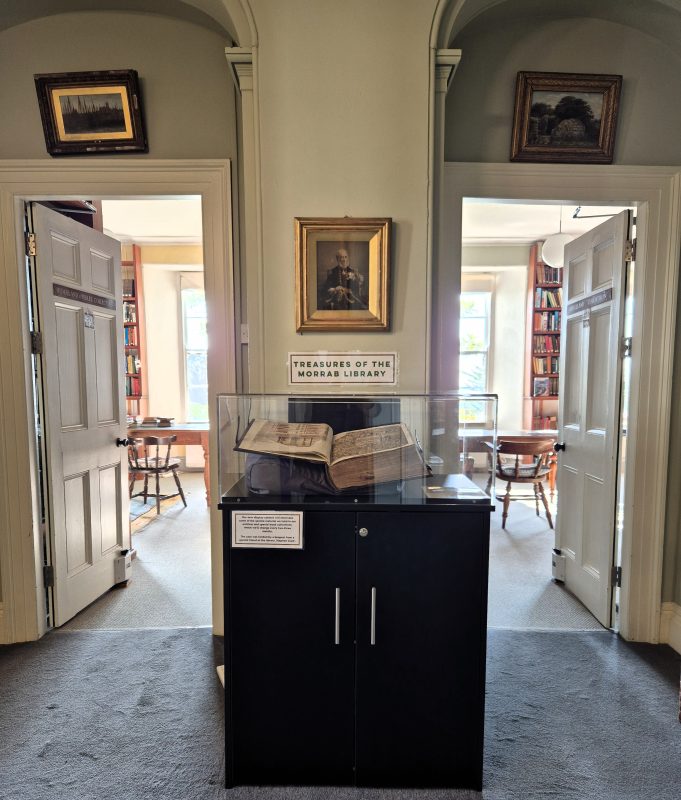
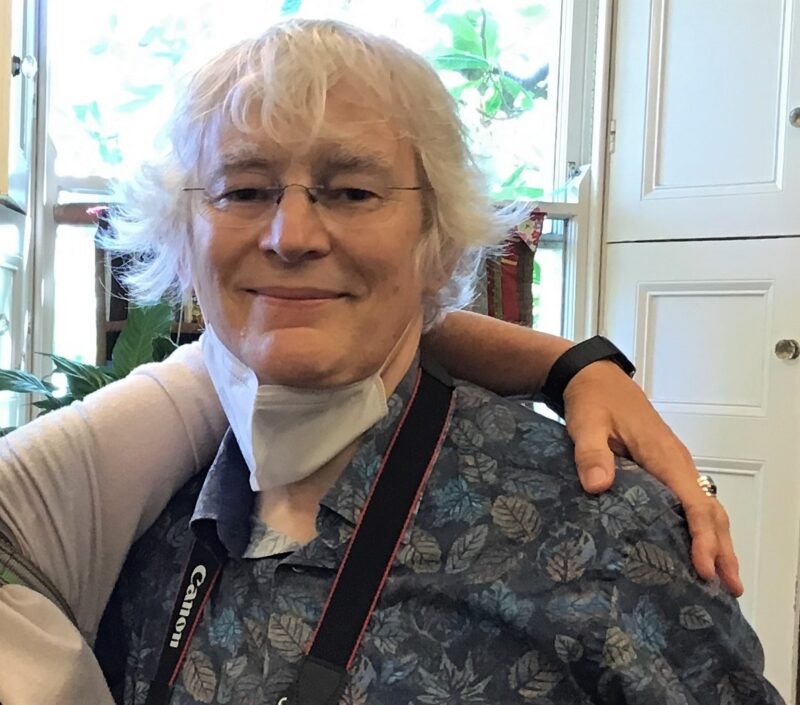
This new display case came to us via a bequest from the late Dr. Stephen Clark, much-loved life member, volunteer and former Trustee, who passed away on the 2nd of March, 2022. Steve loved the Morrab Library, volunteering for reception desk duty, joining the library’s Book Selection Committee, as well as being a founding member of the Library’s Poetry Group. His fresh-baked cakes were legendary. You can read more about Steve here.
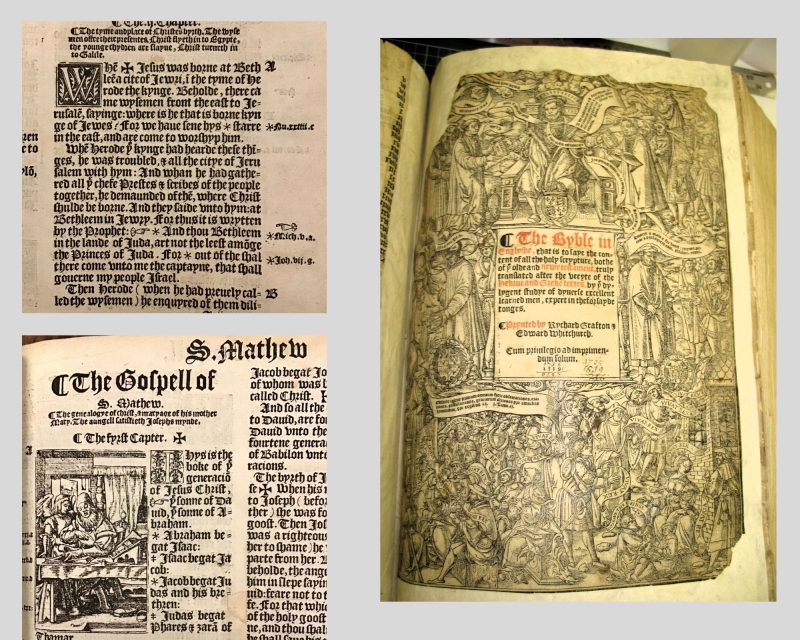
Our biggest dilemma was deciding which of our collections we would display first, from a choice of hundreds. We settled on Henry VIII’s Great Bible of 1539. A donation to the library, it is a significant historical work, and asks all sorts of questions about when it came to the library and from whom. It is just one of thousands of historical books held in our special collections. Members and researchers are welcome to view these books, by appointment. And while we wait for them to be listed electronically through our library management system, KOHA, in the next few years, they are currently searchable in our card catalogue, and we also hold a separate listing. Staff will be able to help you discover our holdings.
We look forward to bringing you treasures from the collections in the coming months.
Read on to find out more about this important work.
The Great Bible (London), 1539
E220.5201
The Great Bible, so called because of its size, was the first royally commissioned printed Bible in English. The title page shows Henry VIII, seated on his throne, presenting a Bible in either hand to clerics on the one side and laymen on the other. Below to the left and right are Thomas Cranmer, Archbishop of Canterbury, and Thomas Cromwell distributing Bibles. This picture conveyed an important political message: that the Pope’s authority over the Church in England had been replaced by Henry VIII’s royal supremacy, and that the Bible should be accessible to the poorest subjects in the realm.
Despite the best efforts of one of our volunteers, we weren’t able to establish the complete provenance of the copy we hold, although we do know it belonged to the Borlase family, with a George Borlase of Penzance signing his name in it in 1758, near to what appears to be a calculation of the age of the Bible at the time of ownership (1758-1539 = 219). George’s signature appears again with a date beginning “175”, but during later conservation the recto side of the page was severed, cutting off the last number.
The most likely George Borlase of Penzance is the son of John Borlase of Pendeen (1666-1755). The latter was also the father of Walter Borlase of Castle Horneck and William Borlase of Ludgvan. George was born in St Just in 1697, lived in Penzance, and died in Kent in 1769.
The frontispiece of the Bible has the arms of the Borlase family with ‘John Borlase of Helston’ written below. There are two possible owners of this bookplate . One, John Borlase (1764-1844), was an attorney, the son of George Borlase b. 1725. The latter was the son of the aforementioned George Borlase.
The second was John Borlase (1795-1879), a surgeon in Helston. He was the son of John Bingham Borlase (1753-1813), whose father was Walter Borlase, who was the son of the aforementioned George who signed the Bible.
All available copies of the Borlase family’s Wills have been examined but no mention of the Great Bible is made in any of them.
Information courtesy of Kay Line, Library volunteer, March 2026.
by Lisa Di Tommaso | Aug 26, 2025 | Blog, Morrab Library
One of our Library volunteers, Michael Malone-Lee, recently happened upon an unusual, witty, anonymously published poem in an innocuous volume in the Theology Room, dating from 1811.
Enchanted and intrigued, Michael delved deeper to uncover its author, the Revd. C. Valentine Le Grice (1773-1858), and explores the background to his entertaining piece, The Petition of an Old Uninhabited House in Penzance to its Master in Town.
The poem is a lament for the past in which the poet contrasts the ancient, ruined house with the contemporary gentrification of Penzance, a subject perhaps still of relevance today.
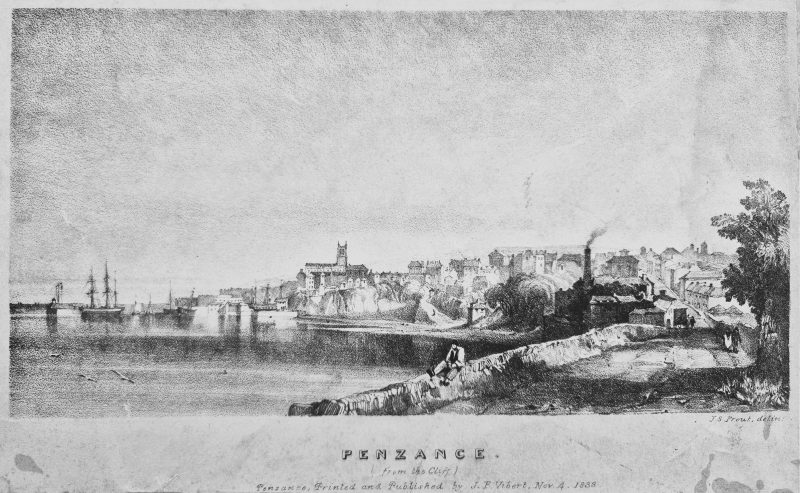
A view of Penzance, printed and published by J.F. Vibert, 1833 (MOR/VIV/16)
by Lisa Di Tommaso | Jul 14, 2025 | Acquisitions, Blog, Morrab Library
When former Morrab Library President and Patron John le Carré passed away in 2020, his extensive book collection was donated or sold across various locations. The library made the decision to acquire one of these volumes, which holds a particular special link to the library, through two people who played important roles in its history and collections.
Richard Carew (1555 – 1620) was a Cornish scholar of antiquities and his Survey of Cornwall, first published in 1602 , is an important title in its own right. The volume details the geography, history, and culture of Cornwall at the time, and offers insights and observations that reflect Carew’s own personal experiences and knowledge of the region. Carew aimed to document the distinctiveness of Cornwall, its natural resources, and its people. This particular volume is the 1811 edition (held at: SPC 942.37).

While we’re not certain of the circumstances that led Mr le Carré to purchase this title, it is not beyond the realms of belief that its previous owner proved a significant influence. The book carries the bookplate of Arthur Quiller-Couch (1863-1944), or ‘Q’, a Cornish novelist, scholar and literary critic. The library holds many of Q’s works, and in a speech to the library in 1919, said of the Morrab:
“There are some things in this world which the traveller, if he has eyes to see, can’t help but find just right. [It is not] fanciful to suppose …a guest at closing time, resting his strained eyes on the view across Mount’s Bay, with a sense that here was the real world scarcely less enchanting than the visionary sea of marvels, a city of God behind him, upon which the caretaker was closing the shutters for another night…”
 Arthur Quiller-Couch
John le Carré was was a passionate supporter and friend of The Morrab Library for many years. As well as holding the role of President from 1997-2002, he later continued for many years as our Patron. His relationship with the Library stretched even further back to the 1970’s, giving his time to many events and meetings to support the library over the years. Mr le Carré supported the library in many ways, including establishing the Morrab Fellowship, which for a number of years provided a bursary to local sixth-formers to purchase books for their studies. He also commissioned the construction of a number of the mahogany reading tables located in our rooms upstairs, and he paid the insurance premium on our book collection throughout his tenure as President. Mr le Carré will be remembered for his vision for the library’s future, and his aim of encouraging young people to join and be inspired by this special place.
 John le Carré pictured with Morrab Library colleagues in 1975
So Richard Carew’s important tome provides a special link to two of the library’s most interesting and important supporters.
At the back of the volume, there is a page of unattributed handwritten annotations on the subject of Cornish etymology. Intrigued by this, one of our brilliant library volunteers, Jane Prince, delved into the background of the provenance of Carew’s volume, exploring the possibilities of how it may have come into the hands of Arthur Quiller-Couch, before passing to John le Carré, and uncovering who may very likely have been been responsible for the mysterious note. Her paper follows…

The mysterious, unattributed notes
“This volume, which contains Sir Arthur Quiller-Couch’s bookplate, was accompanied by a slip from the sales house mentioning the notes made by a former owner, suggesting that these may have been made by Q himself. However, a comparison with the facsimile of a letter in Q’s handwriting in Brittain’s biography shows that this is not the case. However, the cross-references in these notes to Halliwell (probably to his Rambles in Western Cornwall of 1861) indicate that the volume might, in fact, have been a survivor from the library of Q’s father, Dr Thomas Quiller Couch.[1] Most of his books were sold to pay debts on his death in 1884, when Q, still an undergraduate at Trinity, Oxford, was left the head of the family with a mother, two sisters and two much younger brothers to support. The reference in Q’s autobiography implies that he kept some of his father’s extensive library.[2]
 Arthur Quiller-Couch’s bookplate in Carew’s 1811 volume
James Orchard Halliwell (later known as Halliwell-Phillips) was a contemporary of Thomas Couch and they had a common acquaintance in J. T. Blight, who was a friend of Thomas and who also illustrated Halliwell’s Life of Shakespeare (1848). A footnote referencing Halliwell’s Rambles accompanies the details of Chapel Uny Well taken from Thomas’s original notes for Ancient and Holy Wells of Cornwall, which was published, with additional research, by Q’s sisters Mabel and Lilian.[3] The entry for Scarlet’s Well, Bodmin, quotes Thomas Couch’s manuscript in full in which he in turn quotes from Carew’s Survey.[4] A footnote to St Nun’s Well, Alternon also refers to Carew’s Survey but citing the 1769 edition, although it could have been the case that Mabel and Lilian just looked up the reference in that particular edition. Ancient and Holy Wells was published in 1894 by which time Q was living and working in Fowey, so his sisters would no longer have had access to their father’s copy of Carew.[5]
The Morrab Library is fortunate in having an archive of J. T. Blight’s sketchbooks and diaries, including a letter to him from Thomas Couch. The annotations to Carew’s Survey are only rough notes and Thomas Couch’s letter is in formal handwriting but similarities between certain letters seem to support the proposal that the book originally belonged to Q’s father.[6]
The cross references to Halliwell are also of relevance to the Morrab Library in that Halliwell donated more than 2,000 volumes to the library after visiting it during his stay in Penzance. Halliwell lodged with Mrs Margery Cornish in Clarence Street and his explorations of the district resulted in Rambles in Western Cornwall By the Footsteps of the Giants published by John Russell Smith, London, in 1861. His obituary in the Cornishman of January 1889 described Halliwell’s donations of ‘rare and valuable books’ as making ‘one department richer than any other provincial library of its size in Elizabethan and Dramatic literature.’ [7] He was best known as a Shakespearian scholar. He was also educated at Jesus College, Cambridge where, co-incidentally, Q was granted a fellowship twenty years after Halliwell’s death.
 Bookshelves in the Library honouring Halliwell
 J.O. Halliwell-Phillips
If, however, Q did not inherit the volume of Carew from his father it is likely that he bought it from Gustave David, the antiquarian bookseller who kept a stall in the market in Cambridge and was much patronised by Q and his contemporaries. David attended book sales in London every week and his Cambridge stall (and later his shop) was well-known as a source of hidden treasures at reasonable prices. He used to put aside volumes which he thought would interest his regular customers. In 1925 Q and others gave a lunch at Cambridge in honour of David, and Q contributed to a small book produced as a memorial tribute in 1937, entitled David of Cambridge: Some Appreciations.[8]
- F. Brittain, Arthur Quiller-Couch: A biographical study of Q, (Cambridge, 1947), p. 117.
- Memories and opinions. An unfinished autobiography by Q, ed. S. C. Roberts, (Cambridge, 1944), p. 91.
- Mabel and Lilian Quiller-Couch, Ancient and Holy Wells of Cornwall, (London, 1894), p 28.
- Ibid pp. 211-212.
- Ibid p. 172
- Morrab Library Archive: MOR/BLI/1
- The Cornishman, Thursday, 10th January 1889, no. 549, p. 7.
- David’s son Hubert (1900-1990) continued the business and was also a designer of book-plates.
by Harriet-Jade | Jul 3, 2025 | Uncategorized
The fascinating and tragic story of J.T. Blight has captured the imagination of writers and artists over many years. Library member Patricia Wilson Smith has written the fourth instalment of a blog for us about how Blight‘s story has inspired her…
This is my final blog before I take a break to start work on my experimental film, and I thought it would be interesting to explore Blight’s story from the perspectives of two men who had such a formative influence over his life and work.
The Revd. Robert Hawker, vicar of Morwenstow, was in his mid-fifties when he took John Blight under his wing. Best known in Cornwall today, for writing Trelawney, or The Song of the Western Men (the well-loved Cornish anthem), his reputation then was as poet and eccentric, as was his obsession with retrieving drowned mariners from the foot of the cliffs to give them a Christian burial. John Blight counted him a ‘great man’ and hoped for his help in producing and promoting a second volume of Ancient Crosses and Antiquities that he was planning, recording the antiquities of East Cornwall. Hawker was indeed very helpful to Blight, encouraging the development of his work, but he was not a disinterested mentor, and soon began to insist on inserting poems of his own, and other irrelevancies that Blight attempted to resist. Hawker was a man of strong passions, but not of lasting vindictiveness, and despite a serious ‘falling-out’ later, it seems the two men remained friends for many years. Hawker was instrumental in obtaining a royal declaration for this second volume of work, and for recruiting the subscribers that were needed to publish it.
Robert Hawker as drawn by JTB in 1856
James Orchard Halliwell, in 1863
James Orchard Halliwell was a man of very different enthusiasms; coming from a privileged background as the son of a wealthy draper, he was educated at Cambridge and before the age of twenty had published many learned articles in the arts, science and literature journal, The Parthenon. He secured the friendship of a noted bibliophile, Sir Thomas Phillipps, and befriended his daughter Henrietta, later proposing marriage to her. He was then involved in a scandal in which he was suspected of having stolen valuable manuscripts from Trinity College. No prosecution could be made, but Halliwell was banned from the British Library, and Phillipps refused to give his consent to their marriage. The pair eloped in 1842.
James Halliwell was in his early forties when he visited Penzance on a holiday with his wife and children. It was 1861, and Blight’s ‘A Week at the Lands End’ had just been published. Henrietta Halliwell referred to it constantly during their travels around West Penwith, and it’s likely that they also referred to his volumes on Ancient Crosses and Antiquities. Halliwell wrote and published his own ‘Rambles in Western Cornwall’ shortly after. It is interesting to compare the two ‘travelogues’, and easy to imagine Blight’s straightforward and informational little book being mined for information by the older, more worldly, Halliwell. In comparison ‘Rambles’ seems decidedly quaint in appearance, but would have received a far wider, wealthier and influential audience at the time.
Preface page to A Week at the Lands End published by Blight in 1861
Preface page to Halliwell’s Rambles in Western Cornwall
Hearing of Halliwell’s visit, and desperate for the opportunity to better himself through his talents, Blight contacted him to offer his services as an illustrator.
The following year brought John Blight the opportunity to work for this illustrious and successful client. He was neither an experienced negotiator nor a man of the world like his future employer, and entered into what, to our eyes today, appears to have been a one-sided arrangement in which Blight worked obsessively to record Shakespeare’s birthplace (Halliwell’s perennial project) in return for being an occasional guest on holiday trips and at the Halliwell’s home, and expenses incurred when working in Stratford. Being a quiet and sensitive man, he was initially stimulated by the attention and genuine affection he received, and felt unable to demand what he was rightly due. The Shakespeare volumes materialised slowly, never repaying the amount of work Blight had put into over 600 drawings and etchings that he had, in his enthusiasm, given over directly to Halliwell.
In successive years Blight’s reputation as an archaeologist grew, but it was not an occupation that attracted a regular income. Overwork and desperation about money contributed to John Blight’s breakdown which began in 1868, and his attachment to a local woman, Evelina Pidwell seems also to have contributed to his downfall. James Halliwell became aware of his friend’s struggles when he began to write desperate letters asking for commissions, but choosing to ignore the signs, Halliwell eventually threatened to ‘cut’ him. Only when Blight’s father wrote to him explaining the difficulties they were experiencing as a family, did Halliwell show any concern for the artist. It is significant that James Halliwell was among those responsible for setting up a fund to pay for Blight’s confinement at Bodmin asylum, and was undoubtedly one of those alluded to in this letter from the St Lawrence
Hospital Management Committee, dated 1968, to a Blight researcher:
“…when he was admitted…the Form of Guarantee signed by Robert Blight and Thomas Cornish was for one month only…However, from the correspondence it would appear that interested people or relatives were making arrangements for a further Guarantee of a longer duration”. (Extract from letter to Miss M Ingleden, 12 February 1968)
Writer John Mitchell (A Short Life at Lands End, 1977), deeply sympathetic to John Blight’s story, concluded:
“Blight’s ‘death to the world’, as Halliwell put it, took place with his committal to the Asylum when he was thirty-five, his active life was indeed a short one. Halliwell’s carefully ambiguous phrase, which occurs in the introduction to his Calendar*, printed in 1887, gives a clue to how matters stood at the time. He was surely aware that Blight lingered on at Bodmin, yet he said nothing. Evidently he, Parker, Boase and others were parties to an agreement, tacit or formal, that …Blight should be considered as not only dead to the world but dead and buried.“
*A Calender of the Shakespearean Rarities, Drawings and Engravings formerly preserved at Hollingbury Copse, near Brighton, 1887, refers to the work of Halliwell and Blight in recording architecture contemporary with Shakespeare in Stratford-upon-Avon and elsewhere, with a long list of Blight’s drawings in Halliwell’s possession.
© patricia wilson smith 2025
https://patriciawilsonartist.com/news