We are excited to tell you about a special new addition to the library – a purpose built display case. This will allow us to install a rotating exhibition of rare and important treasures from our book and archive collections, which are usually kept locked away in secure and environmentally protected storage. You’ll find it on the first floor at the top of the staircase.
We wanted to find a way to ensure that our members and visitors not only knew about the special collections we hold in the library, but to be able to see and learn about them.
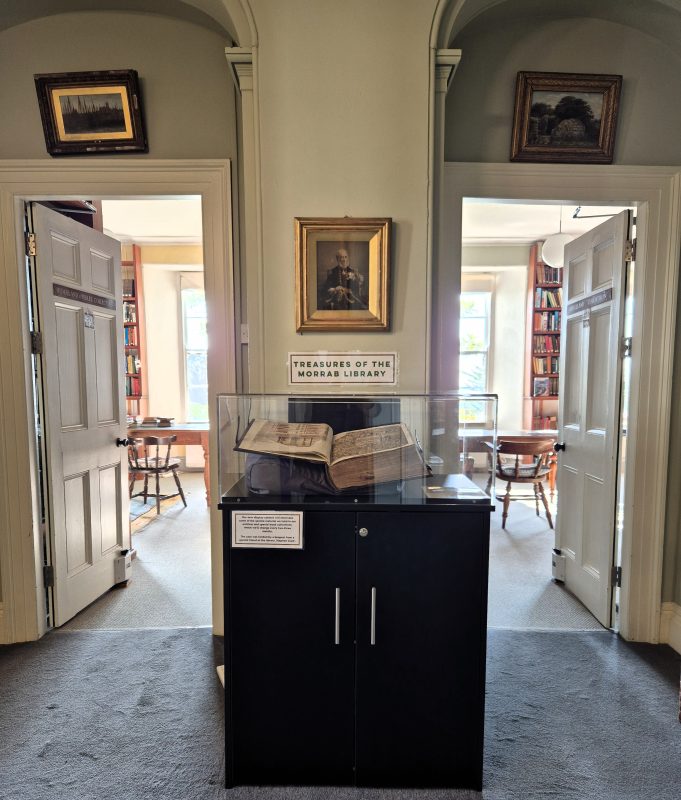

This new display case came to us via a bequest from the late Dr. Stephen Clark, much-loved life member, volunteer and former Trustee, who passed away on the 2nd of March, 2022. Steve loved the Morrab Library, volunteering for reception desk duty, joining the library’s Book Selection Committee, as well as being a founding member of the Library’s Poetry Group. His fresh-baked cakes were legendary. You can read more about Steve here.
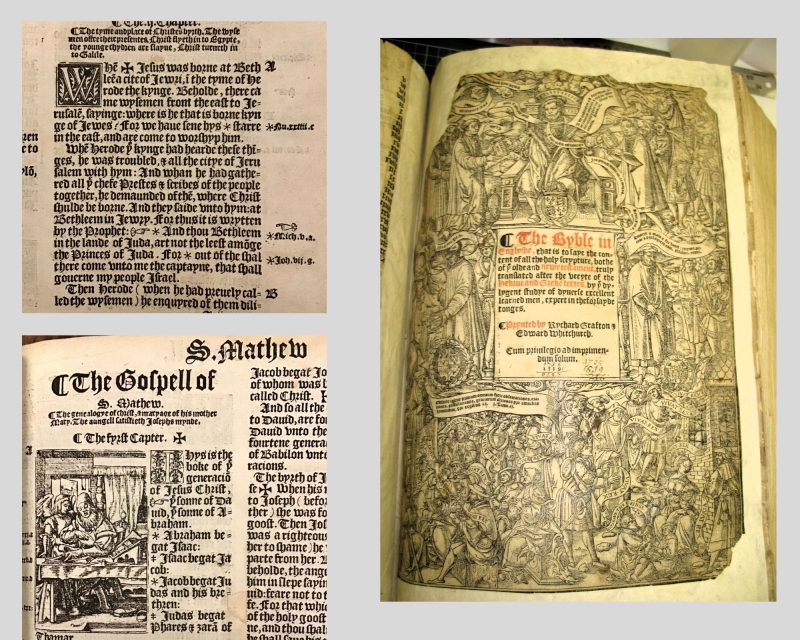
Our biggest dilemma was deciding which of our collections we would display first, from a choice of hundreds. We settled on Henry VIII’s Great Bible of 1539. A donation to the library, it is a significant historical work, and asks all sorts of questions about when it came to the library and from whom. It is just one of thousands of historical books held in our special collections. Members and researchers are welcome to view these books, by appointment. And while we wait for them to be listed electronically through our library management system, KOHA, in the next few years, they are currently searchable in our card catalogue, and we also hold a separate listing. Staff will be able to help you discover our holdings.
We look forward to bringing you treasures from the collections in the coming months.
Read on to find out more about this important work.
The Great Bible (London), 1539
E220.5201
The Great Bible, so called because of its size, was the first royally commissioned printed Bible in English. The title page shows Henry VIII, seated on his throne, presenting a Bible in either hand to clerics on the one side and laymen on the other. Below to the left and right are Thomas Cranmer, Archbishop of Canterbury, and Thomas Cromwell distributing Bibles. This picture conveyed an important political message: that the Pope’s authority over the Church in England had been replaced by Henry VIII’s royal supremacy, and that the Bible should be accessible to the poorest subjects in the realm.
Despite the best efforts of one of our volunteers, we weren’t able to establish the complete provenance of the copy we hold, although we do know it belonged to the Borlase family, with a George Borlase of Penzance signing his name in it in 1758, near to what appears to be a calculation of the age of the Bible at the time of ownership (1758-1539 = 219). George’s signature appears again with a date beginning “175”, but during later conservation the recto side of the page was severed, cutting off the last number.
The most likely George Borlase of Penzance is the son of John Borlase of Pendeen (1666-1755). The latter was also the father of Walter Borlase of Castle Horneck and William Borlase of Ludgvan. George was born in St Just in 1697, lived in Penzance, and died in Kent in 1769.
The frontispiece of the Bible has the arms of the Borlase family with ‘John Borlase of Helston’ written below. There are two possible owners of this bookplate . One, John Borlase (1764-1844), was an attorney, the son of George Borlase b. 1725. The latter was the son of the aforementioned George Borlase.
The second was John Borlase (1795-1879), a surgeon in Helston. He was the son of John Bingham Borlase (1753-1813), whose father was Walter Borlase, who was the son of the aforementioned George who signed the Bible.
All available copies of the Borlase family’s Wills have been examined but no mention of the Great Bible is made in any of them.
Information courtesy of Kay Line, Library volunteer, March 2026.